
Table of Contents
This article is part of the Netaxis Inspiration Day 2026 thought leadership series. It combines current market data, official EU policy direction, and forward‑looking estimates to describe the likely digital sovereignty landscape in Europe in 2026. Where precise outcomes or figures are uncertain, projections and assessments are explicitly framed as such.
Executive Summary
Digital sovereignty has become a defining strategic issue for Europe. By 2026, control over data, compute capacity, and digital infrastructure increasingly shapes not only economic competitiveness but also democratic resilience and geopolitical autonomy.
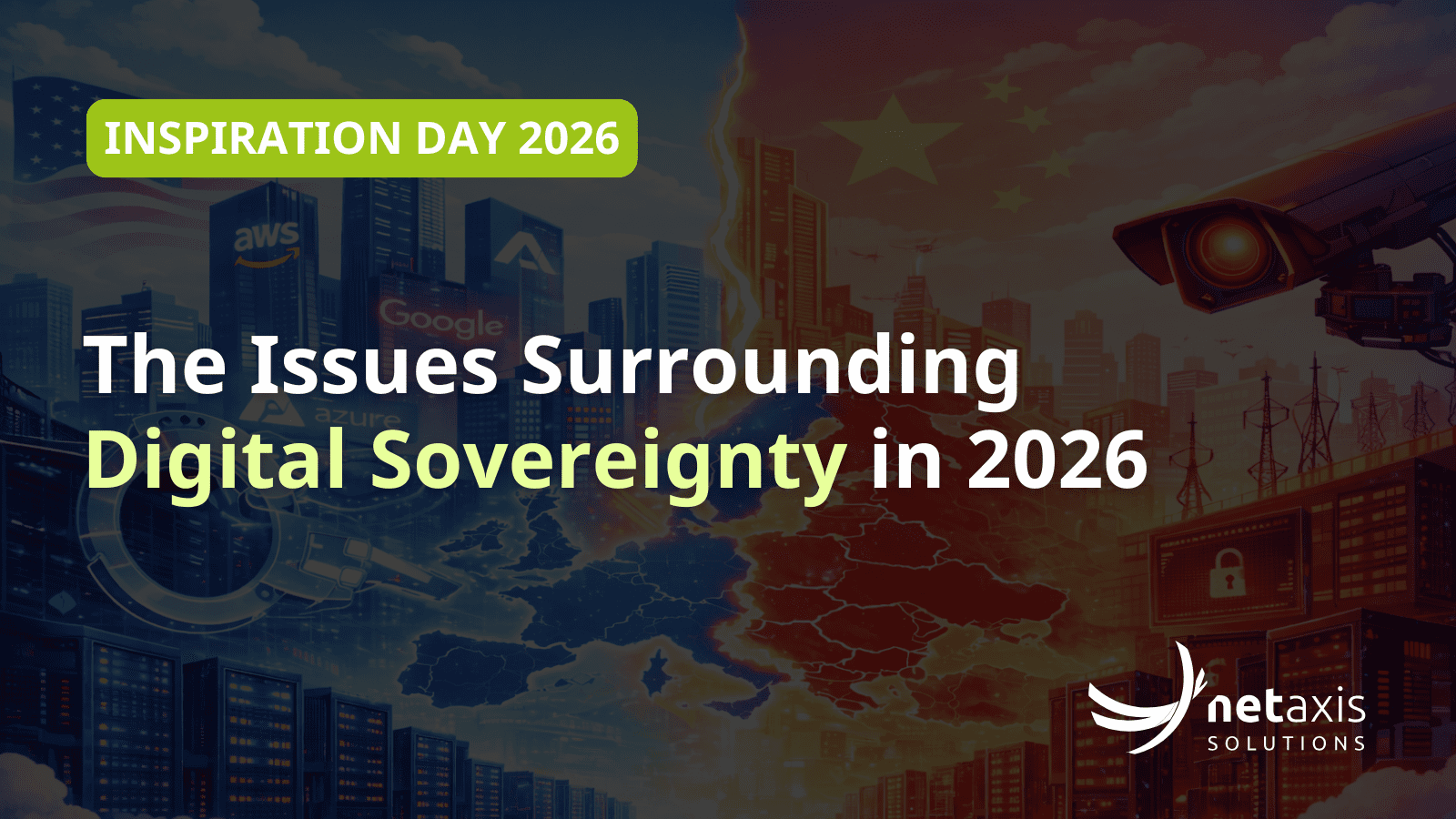
Europe faces a structural dilemma. It remains deeply dependent on American hyperscalers for cloud and AI services, while simultaneously seeking to reduce exposure to Chinese‑controlled hardware, platforms, and supply chains. In response, the European Union and its member states have begun shifting from a regulator‑first posture toward a more investment‑led strategy, mobilising capital across semiconductors, AI infrastructure, cloud services, and deep technology.
This paper argues that Europe’s challenge is no longer awareness, but execution. Achieving meaningful digital sovereignty will require sustained investment at unprecedented scale, pragmatic regulation that enables innovation, and coordinated demand‑side action by governments and large enterprises. Without this, Europe risks remaining technologically dependent — not by choice, but by structural inertia.
These questions form a central theme for discussion at Netaxis Inspiration Day 2026, where leaders from industry, government, and infrastructure will explore how Europe can translate ambition into operational reality.
Europe faces a structural dilemma. It remains deeply dependent on American hyperscalers for cloud and AI services, while simultaneously seeking to reduce exposure to Chinese‑controlled hardware, platforms, and supply chains.
Introduction
By 2026, the concept of digital sovereignty has evolved from a niche policy concern into a central pillar of Europe’s economic security and democratic resilience. For Europeans, digital sovereignty can be understood as the capacity to act independently in the digital sphere, governed by European laws and values, without structural dependence on foreign technological powers.
The challenge is no longer limited to the idea of “buying European.” Instead, it raises a more fundamental question: can Europe remain a democratic, economically viable continent in an era where data, compute capacity, and digital infrastructure define geopolitical power?
1. The Risks of the “Two Hegemons”
Europe finds itself positioned between two dominant digital models: the largely market‑driven American ecosystem and the state‑centric Chinese approach. Each presents distinct and systemic risks to European autonomy.
The American Dependency: The “Golden Handcuffs”
The primary risk associated with American technology providers is structural rather than ideological. As of 2026, an estimated 60–65% of the European public cloud market is controlled by three US companies: Amazon Web Services, Microsoft Azure, and Google Cloud.
Extraterritorial Legal Reach
Under the US CLOUD Act, American authorities may compel US‑based technology companies to produce data held overseas, subject to legal process and international agreements. While this access is not automatic, it introduces persistent legal uncertainty and tension with Europe’s General Data Protection Regulation (GDPR), particularly for sensitive government and industrial data.
The “Lost Internet” Narrative
Some European cybersecurity and intelligence officials have warned that Europe has effectively “lost the internet” — a deliberately provocative shorthand for the continent’s deep reliance on non‑European infrastructure across email, cloud computing, and advanced AI development.
Economic Rent and Cost Exposure
Dependence on US hyperscalers also results in substantial capital outflows from Europe. Analysts warn that European firms may face mid‑single‑digit to low double‑digit increases in cloud costs over the coming years as rising hardware, energy, and AI accelerator costs are passed through to customers.
The Chinese Dependency: Security and Values
While the US dominates software platforms and cloud services, China has established itself as a global powerhouse in hardware manufacturing and digital infrastructure.
Infrastructure and Security Risks
The use of Chinese‑manufactured telecoms and network equipment has generated sustained concern among European governments. These concerns focus on the potential for hidden vulnerabilities or state‑mandated access that could enable surveillance or service disruption during periods of geopolitical conflict.
Value and Governance Misalignment
China’s digital model is closely intertwined with mass surveillance and state control. For Europe, reliance on Chinese‑owned platforms or AI systems raises concerns about electoral interference, data governance, and the long‑term erosion of democratic discourse through opaque algorithmic influence.

2. Geopolitical Uncertainty: The 2026 Landscape
The broader geopolitical environment has transformed digital sovereignty from a strategic aspiration into a defensive necessity.
Fractured Globalisation
Ongoing trade tensions between the US and China, combined with periodic isolationist rhetoric in Washington, underscore that Europe can no longer assume uninterrupted access to critical technologies — even from political allies.
The “Airbus Moment” for Digital Technology
Just as Europe once created Airbus to counter American dominance in aviation, EU policymakers increasingly argue for a comparable effort in AI and cloud infrastructure. A proposed Cloud and AI Development framework, expected to take shape in 2026, seeks to foster home‑grown alternatives by simplifying data‑centre construction, improving interoperability, and encouraging scale across European providers. The ambition is clear, but the financial and technical hurdles remain substantial.
3. The Financial Burden of Independence
Achieving meaningful digital sovereignty requires what many analysts describe as an investment supercycle, carrying significant costs for European taxpayers and businesses.
Key Investment Areas (Indicative Figures)
- European Chips Act: Mobilisation of over €43 billion (£36 billion) by 2030 to increase Europe’s share of global semiconductor production.
- Data Centre Expansion: Construction costs approaching £9.5 million per megawatt, with London and Zurich among Europe’s most expensive markets.
Research and Innovation: Approximately £11 billion allocated in the EU’s 2026 budget for AI‑related research and the Digital Europe programme.
Achieving meaningful digital sovereignty requires what many analysts describe as an investment supercycle, carrying significant costs for European taxpayers and businesses.
4. The Sovereignty Paradox
Europe’s central dilemma in 2026 is that the very regulations designed to protect sovereignty may inadvertently hinder innovation. If compliance regimes — particularly under the EU AI Act — become excessively burdensome, European startups and SMEs may struggle to scale, reinforcing the dominance of large foreign firms with the legal and financial capacity to absorb regulatory complexity.
The challenge is to balance safeguards with growth: ensuring trust, transparency, and accountability without creating barriers that discourage experimentation or drive innovation abroad.
Ultimately, Europe’s digital sovereignty project is a race to establish a credible “third way” — a digital ecosystem that is innovative and competitive, operationally efficient, and firmly governed by European law and democratic norms.
European Companies Positioned as “Sovereign” Alternatives
To avoid becoming a mere “digital colony” of the US or China, Europe has begun scaling national and regional champions designed to prioritise data protection, legal autonomy, and infrastructure control.
AI and Cloud Leaders
- Mistral AI (France): Expanding beyond model development to emphasise European‑based compute and data residency, while engaging closely with Europe’s semiconductor ecosystem.
- Aleph Alpha (Germany): Focused on enterprise and government use cases, prioritising explainability and auditability for regulated sectors.
- DeepL (Germany): A globally competitive translation and language‑AI provider operating under strict GDPR‑compliant data handling.
- OVHcloud (France): Europe’s largest independent cloud provider, significantly reducing exposure to US extraterritorial legislation.
- T‑Systems / Deutsche Telekom (Germany): Offering sovereign and regulated cloud environments with European‑controlled encryption and governance layers.
- Schwarz Gruppe – STACKIT (Germany): A cloud platform designed around European retail, logistics, and public‑sector requirements.
Productivity and Communication Tools
Public Funding and Strategic Programmes in 2026
By 2026, the European Union has begun shifting from a predominantly regulator‑led approach to one that combines regulation with large‑scale strategic investment.
- Chips Act 2.0: Public‑private commitments approaching €80 billion, targeting a 20% global semiconductor market share.
- InvestAI: A mobilisation target of up to €200 billion to support European AI infrastructure and large‑scale compute.
- Deep‑Tech Funding: Continued support through the European Innovation Council, Horizon Europe, and the Digital Europe Programme.
Implications for Leaders and Decision‑Makers
For executives, policymakers, and technology leaders, digital sovereignty is no longer an abstract policy debate. It is a set of concrete decisions affecting procurement, architecture, compliance, and long‑term risk.
Key questions now confronting European leaders include:
- How much strategic dependency is acceptable in critical digital infrastructure?
- Where must sovereignty be absolute, and where is managed interdependence sufficient?
- How can regulation, investment, and procurement be aligned to support European scale‑ups rather than entrenching incumbents?
Addressing these questions requires collaboration across public and private sectors — and a willingness to rethink long‑standing assumptions about cost, efficiency, and control.
Why This Matters for Netaxis Inspiration Day 2026
Netaxis Inspiration Day 2026 is designed to move the conversation beyond diagnosis and into execution. Against a backdrop of accelerating geopolitical fragmentation and technological concentration, the event will focus on practical pathways toward resilience:
- Translating sovereignty principles into enterprise architecture decisions
- Understanding real trade‑offs between cost, control, and compliance
- Identifying where European providers are ready today — and where gaps remain
- Exploring how collective demand can accelerate European‑scale infrastructure
Held in Sorrento in May 2026, the event brings together senior leaders from technology, infrastructure, finance, and public policy to engage with one of Europe’s most pressing strategic challenges.
This paper is intended not as a conclusion, but as a starting point for informed, constructive debate.
Join the conversation
Attend Inspiration Day 2026 for a conversation-driven, network-first approach to industry innovation.